

Polyphasic Awareness: Reclaiming the Intelligence of Dreams & Altered States
justice for perceptual diversity in a world that privileges waking reality

I have felt a love and reverence toward the dreamworld since I was a child. The encounters, locations, visitations all feel sacred and alive. Even the nightmares. I hold reverence toward cultures that have a sustained culture of polyphasic awareness - meaning they value multiple ways of perceiving the world beyond the waking and rational.
When I recall vivid dreams of being welcomed, assisted and connected to ancestors or dream guides I’m recalling real, meaningful access points to my inner wisdom.
As a nurse when I hear the transformational inner experiences of ketamine assisted therapy clients I validate these experiences as forms of insight and portals for integration. I intentionally hold space for patients to speak of their dreams or hallucinatory experiences within the hospital in a non-judgemental way.
Conversely, when I’m told my dreams are meaningless it makes me want to share my dreams even louder.
Sharing our inner experiences is an act of justice for polyphasic culture. It is a method of reviving perceptual diversity in a world that would deeply benefit from expanded awareness.
What is Polyphasic Awareness/Perceptual Diversity"?
Anthropologist Tara Waters Lumpkin, PhD defines perceptual diversity as:
Perceptual diversity allows human beings to access knowledge through a variety of perceptual processes, rather than merely through everyday, waking reality. Many of these perceptual processes are transrational, altered state of consciousness (meditation, trance, dreams, imagination) and are not considered valid processes for accessing knowledge by science
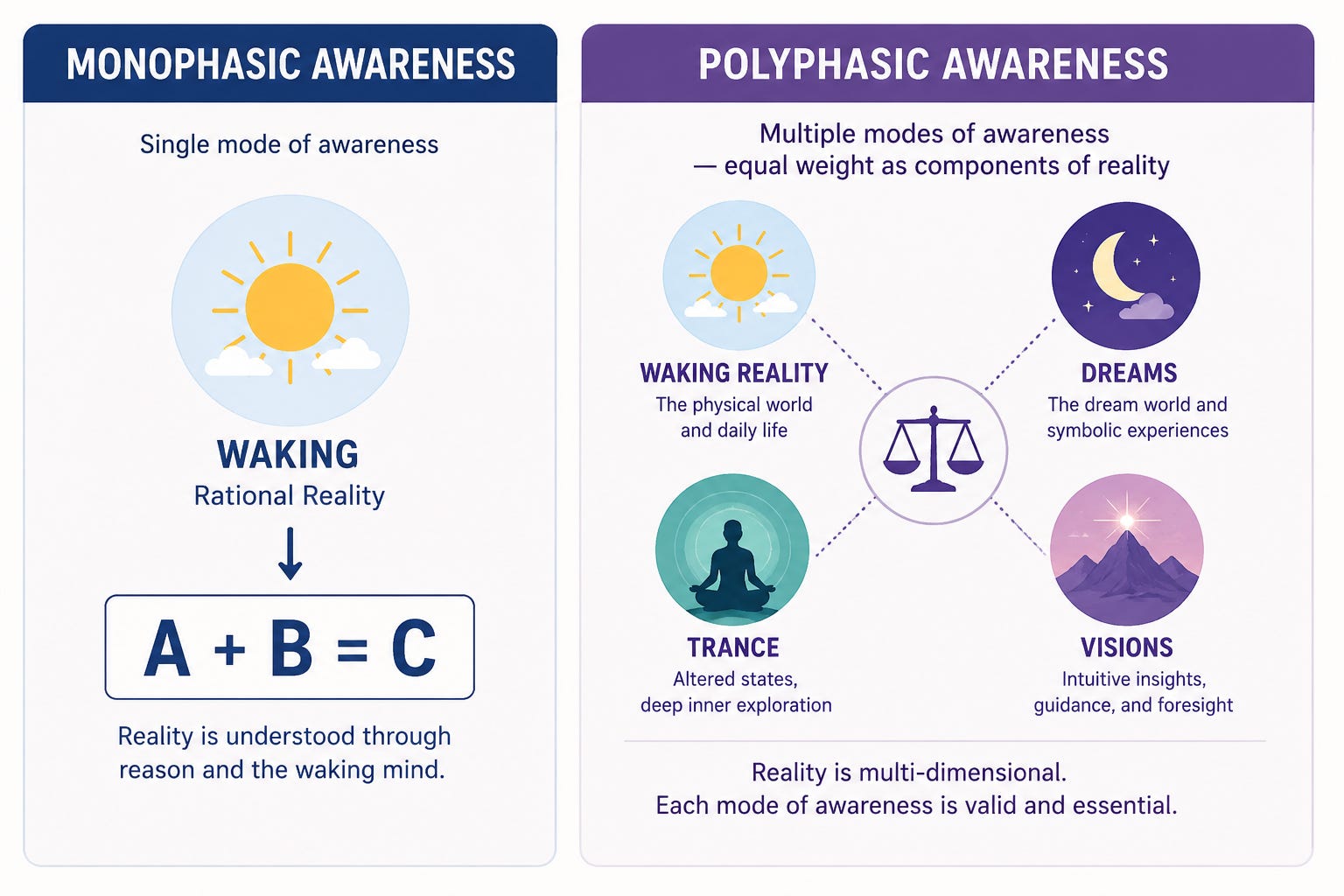
In other words, human experience takes place within a wider perceptual web than just the waking, rational mind. Dreaming, imagination, visions and out of body experiences are respected as additional layers of human experience within this polyphasic framework.
Monophasic Awareness in Western Culture
In predominant Western culture we have been taught that logical thinking and waking ordinary reality are the only forms of experience that are meaningful and useful.
Through the cultural focus of capitalism and consumption we are taught to devalue dreams and to ignore our intuition. There is little to no value placed on the quiet, slow workings of the inner world.
Through the colonial imperialist lens we are taught to look down on cultures that live within a polyphasic way of living. Colonial systems have suppressed Indigenous ceremonial practices, trance traditions, plant medicines and cosmologies that honored altered states as meaningful sources of knowledge and relation.
As humans what are we losing when we constrict our perception to merely rational thinking and the scientific method?
Comparing Monophasic vs. Polyphasic
Here is a basic visual comparison of the different ways of relating to perception.
Why seek Polyphasic Awareness?
When our perception is narrowed to merely the rational world we lose out on forms of intelligence, relation and self expression. People feel separate from their intuition, imagination, dreams and inner visions.
Modern humans have closed themselves off to the reality that we are in constant exchange with all that surrounds us.
-Norma J. & Nisha Burton
When we view life from an interconnected polyphasic lens we foster connection, generosity, acceptance and understanding of ourselves and our role in the wider world. We can honor our truths and see the validity in the beliefs of others.
Together we can cultivate a culture where inner experiences are seen as real and you are encouraged to share your inner world in creative and expressive ways.
My Intention
My goal with Altar Five is to honor the multiple access points of perception that humans experience and to foster a culture where we can share our inner worlds as openly as we share our outer. Where dreaming and waking realities are revered as equally sacred.
Here we can value and honor the ordinary and non-ordinary states as equal, parallel forms of relating to the world.
I joyfully echo the words of Robert Moss:
I have a dream: that we will again become a society of dreamers.
In a dreaming culture, dreams are valued and celebrated
You can subscribe for more:
Dream stories, experiments & incubations
Tales from altered states of consciousness (trance, meditation, psychedelics, drumming)
Shared perspectives - Scientific + Polyphasic
Interviews with people who experience liminal realms & altered states
Poetry
Visual journaling through inner world collage
Reverence for polyphasic cultures
Anthropology + Ethnobotany + Herbalism

Thank you for reading!
If you or your friends have a reverence for perceptual diversity please subscribe + share. May we foster a culture of polyphasic awareness together!
♥ Vickie
The polyphasic frame named something I’ve been living inside without that word. Twelve years of documented dreams — the reverence was never the question for me, the question was always structural: given that the dream is real intelligence, what is it actually building, and how do you learn to read what it’s building in real time?
What I found is that you can’t do that alone. I had a recurring dream for twenty-one years — me as a child in the backseat of a car with no driver, watching landscape pass through the window, no agency over where I was going. It didn’t resolve until I had enough accumulated documentation, enough relational context, enough regulated nervous system to receive what it was actually reporting. The sharing you’re describing isn’t just cultural reclamation — it’s also how the dream gets to finish what it started.
The Emberline is what I call the thread that connects the dreams backward to ancestors and forward to descendants. It’s load-bearing architecture in my work — not metaphor. The sacred and the structural turned out to be the same thing.
Thank you for the frame. Justice for perceptual diversity is exactly right.
I love this! I hope we come back to being a society where we talk about the meaning of dreams too. They used to in ancient times, so why did we stop doing it so much?